
A
Aimee ·
The Editor
Reads like a senior editor. Flags plot holes, character inconsistency, arc collapses. Walks developmental → structural → line → copy → proofreading in order. Cites the chapter every time.
Hire a human$3,500 – $8,000 / book
For novelists who plan
Ink Fortress is a writing workspace that remembers every character, location, and thread across an entire series. Plan on a visual canvas. Write in a calm editor that knows your cast. Edit in five passes. Let the workspace catch the contradictions you'd miss. Then turn your series into a branching adventure your readers play in a free Kindle-like reader.
Story Graph is free forever. No credit card. No expiry.
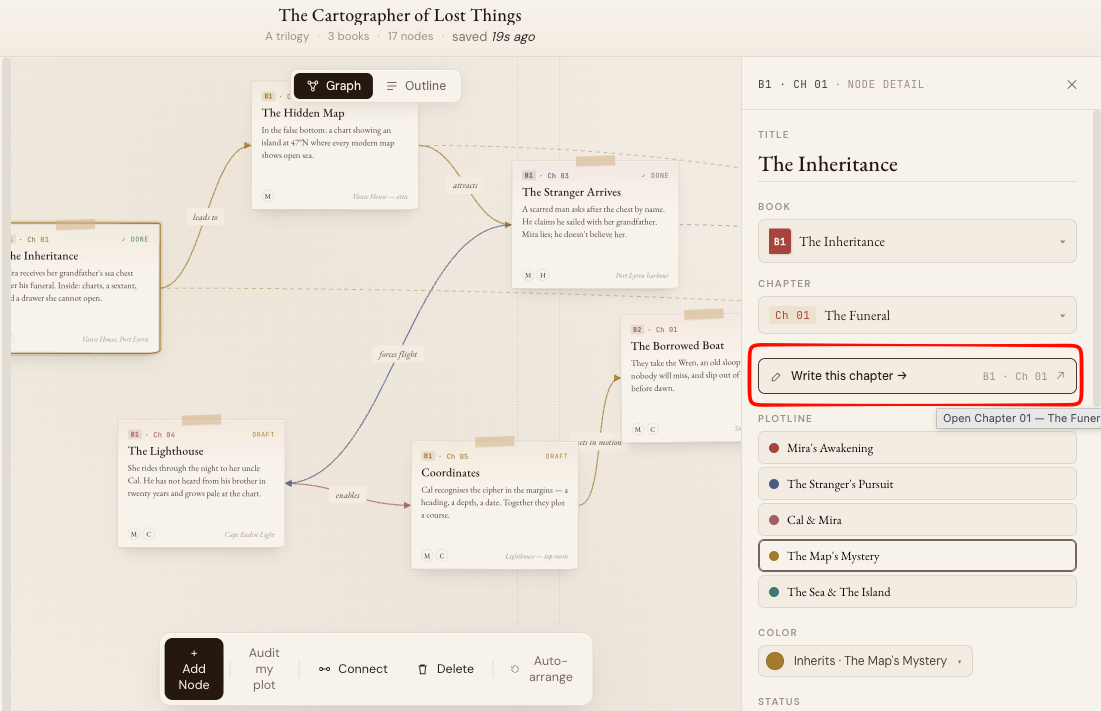
From plot card to chapter. One click.
Tour the workspace →The workflow tax
You didn't sign up to be a project manager. But somewhere between the first draft and the third revision, your story turned into a logistics problem.
You're paying hundreds of dollars a month for tools that don't talk to each other, and spending half your writing time copying text between them. We're proposing something simpler.
Story Graph · The planning canvas
Most plotting tools were built for a single book. Story Graph treats series as native. Books are nodes. Plot threads cross between them. Scenes attach to characters. Reveals connect back to their clues.
One thread, three books, every connection visible — on an infinite canvas, free forever, yours to keep whether or not you upgrade.
The best writers plan backwards. Define the reveal. Place the clues. Weave the threads.
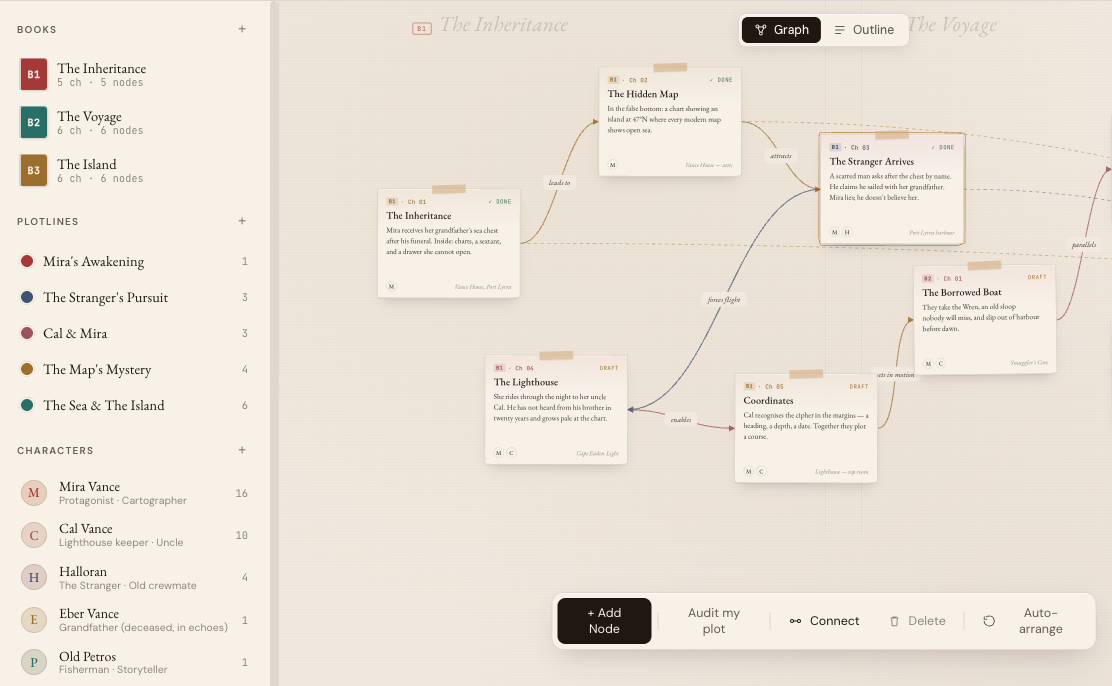
One thread, three books, every connection visible.
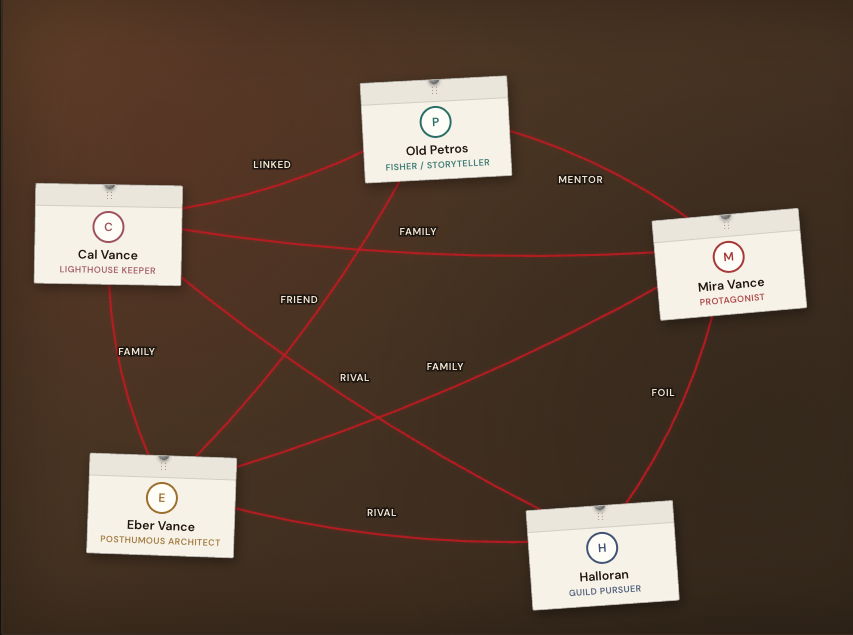
Every alliance, betrayal, and grudge — mapped.
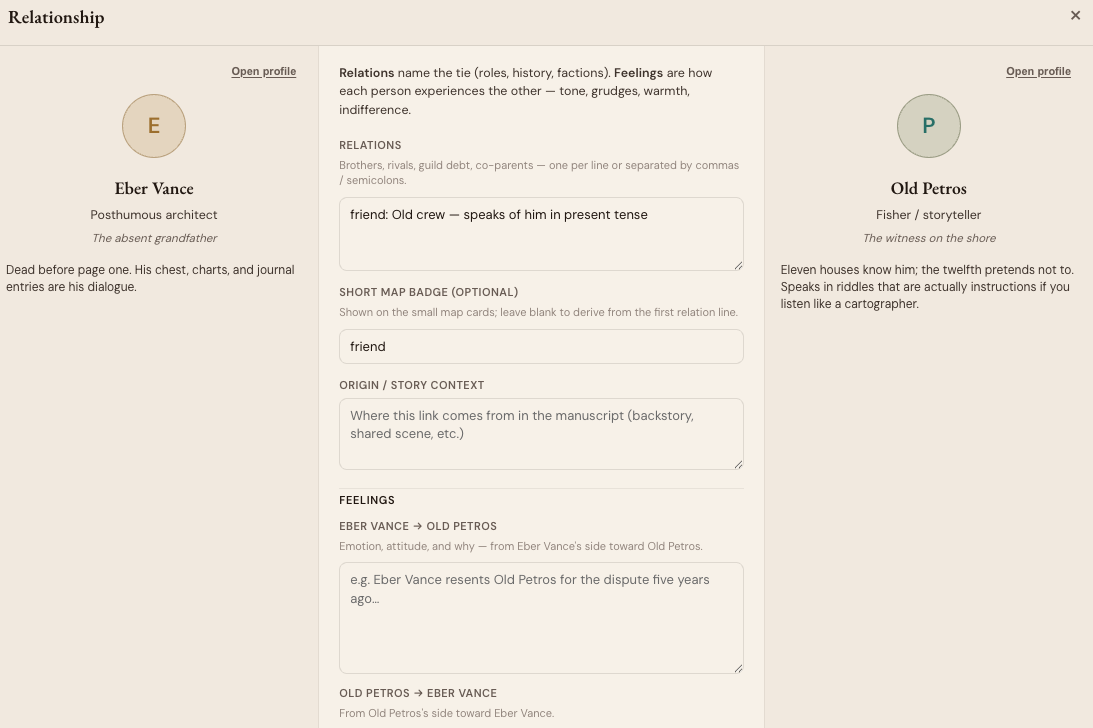
He resents her. She has already forgiven him. Relationships have direction.
Relationship Graph · Character network
Plot is what your characters do. Story is what they become. The Relationship Graph maps every character against every other — alliances, rivalries, secrets, betrayals — across the entire series.
When Sarah lies to Marcus in Ch. 4, the graph remembers. When that lie surfaces in Ch. 19, you'll see it coming because you set it up here.
Plot wants, fears, wounds, and beliefs on one canvas. Build the cast. The story follows.
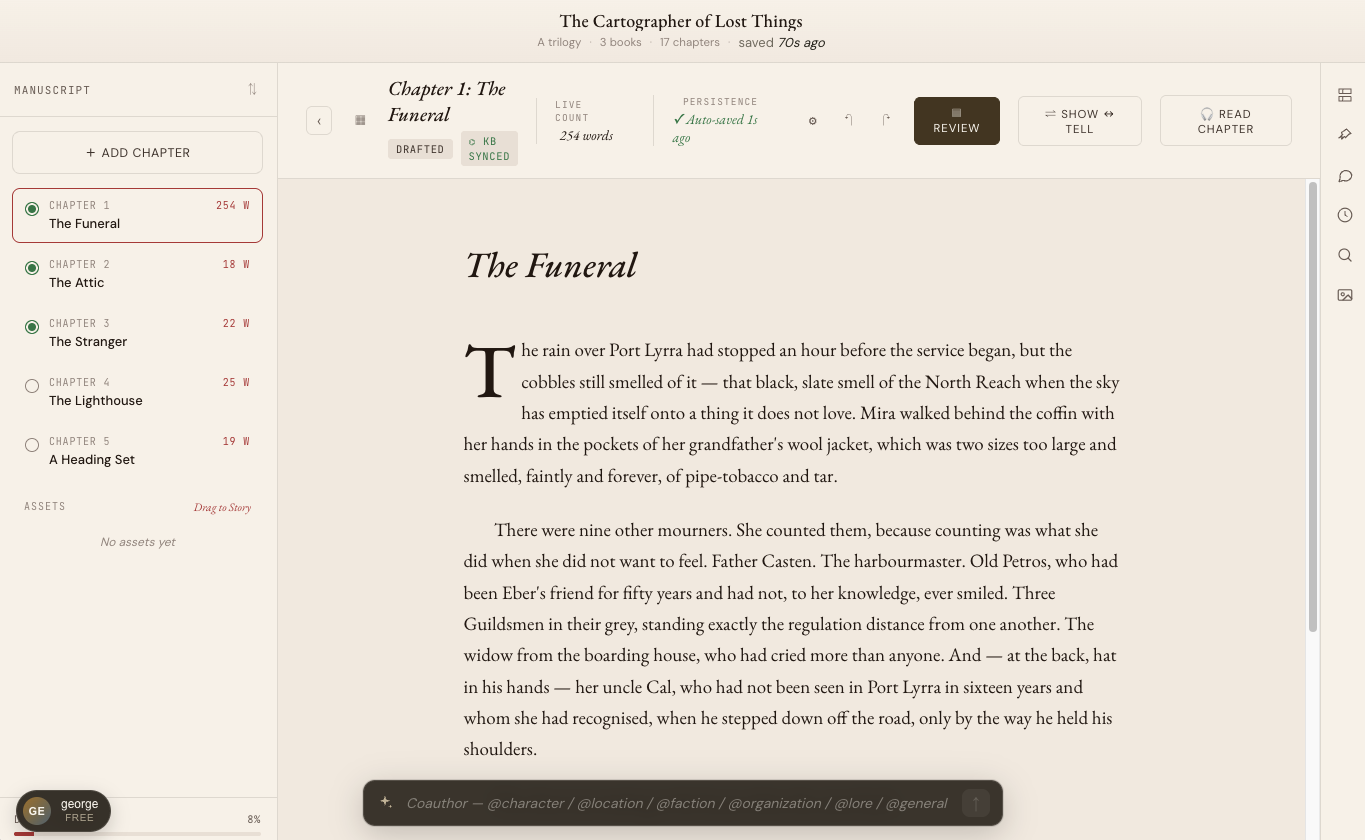
The Editor · Chapter-organised writing
Distraction-free Tiptap editor with proper chapter and scene organisation in the sidebar — the way Atticus or Scrivener handle structure, but inside the same canvas as your plan. Click a plot card in Story Graph; the chapter opens. Click a chapter; it sits next to its node on the graph.
Type @Sarah and the cast you've built drops in. Hover any mention — voice, traits, last appearance, all there.
The Fortress · Series memory
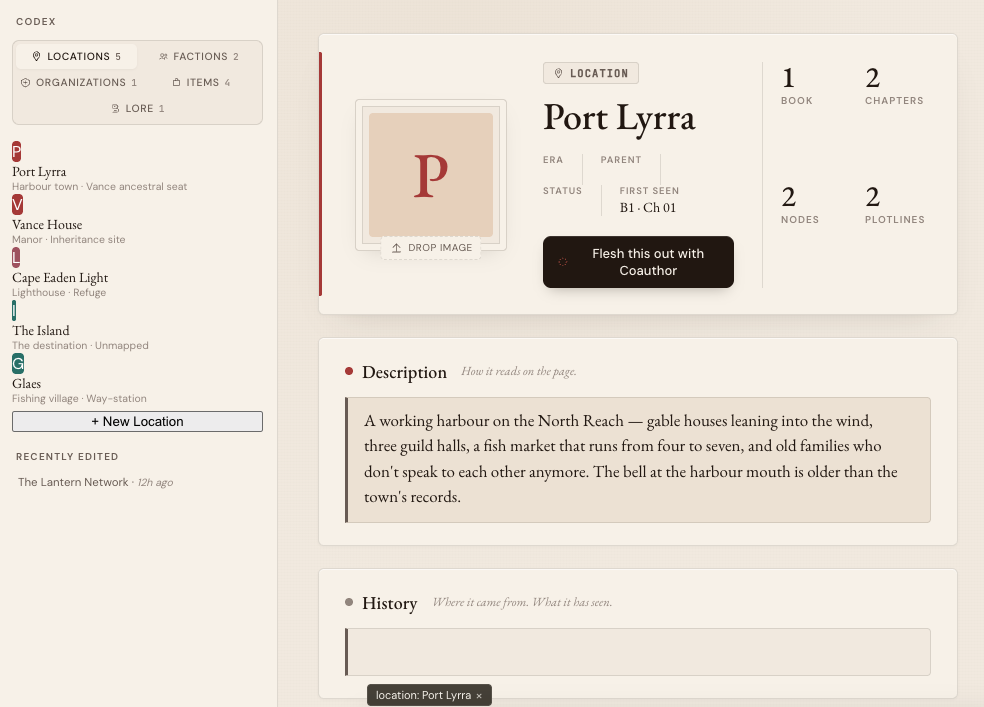
Locations, factions, items, organisations, lore — the Codex is one place for everything in your world. Build a place once; it appears everywhere it's mentioned, with the right details, every time.
Series-wide knowledge base. Auto-built manuscript bible. The character you named in Book 1 still has the same eye colour, the same scar, the same backstory in Book 3. The vault that was empty in chapter 4 doesn't mysteriously contain a map in chapter 19.
Continuity Hub · The catches you'd miss
Every chapter you write is checked against the Fortress in real time. The character who's allergic to peanuts in Book 1 doesn't order pad thai in Book 2. The vault that locked from the outside in chapter 4 doesn't open from the inside in chapter 19.
Series-wide contradiction detection. You see a flag the moment the inconsistency lands — not in the third revision after your beta readers find it.
Continuity flag · Ch. 19
In Ch. 4, the vault was described as locked from the outside, key held by Marcus. Here, Sarah lets herself out without explanation. Want to reconcile?
Continuity flag · Ch. 12
Eliza died 2020in her Codex profile. Here she's referenced as "still teaching last spring." Want to update one?
Adventure Builder · Your world, now playable
You spent five books building a world your readers love. They know your cities, your factions, your villains by name — and they've always wanted to step inside. Now they can.
Take the smuggler from book two. Drop her into The Saltmarsh Crown— she chooses her allies, double-crosses the ones she likes, and carves out a kingdom you never wrote. Every reader's version is theirs alone.
Your lore is already loaded. The Adventure Builder pulls the characters, creatures, locations, and history out of your Fortress and into the adventure — nothing to retype.
They make world-changing choices. Face the factions you created, pick a side, win a throne or lose everything.
Your canon never moves. Readers play inside an instance of your world. Ten thousand readers can each end up on a different throne — your main series stays exactly as you wrote it.
No saga required. Skip the world-building and start a standalone adventure on a blank canvas. The world tools are there when you want them, gone when you don't.
Your canon stays safe. Your world becomes theirs to play in.
Your IP · More than books
Your world is the real asset — a novel is just one way to sell it. Build it once; cash in again and again, to the fans who already love it.
You already did the hard part — building a world people love. Sell it more than once.
$6.4B → $14.8B
interactive fiction market, 2025 to 2034
1.4B
people engaging with interactive narrative content
3.6B
global game players, over 60% of online users
≈6M
Dungeon Crawler Carl copies across the first seven books
Sources: Dataintelo interactive fiction market report, Newzoo 2025 games market reporting, and public Dungeon Crawler Carl sales reporting.
Adventure Builder · No code
Lay your scenes on a canvas. Draw the choices between them. What a reader can do next depends on what they're carrying — and you set every rule with zero scripting.
Carry an artifact. Your reader finds the skeleton key in room two; at the locked gate forty pages later, only key-holders get through.
Run a quest. Gather the 7 Gems of Vorlon — scatter them across the branches; the final path opens only when the set is complete.
Count what matters. 7 romance points. 3 wattle seeds. Cross a threshold, unlock a new ending. Choices add up — and pay off.
Coming soon — the Fortress Game Engine, powered by Core6. We're building in the Core6 universal gaming system — fast d6 dice pools, one-roll combat, and heroes ready in minutes, flexible across any genre. Real RPG mechanics — character stats, skill checks, dice, and combat — drop straight into your adventure with zero code.
Open reader.inkfortress.comThe old way · Why you never built one
Now, the whole thing collapses into
From "learn to code or hire a dev" to "drag, drop, done."
Fortress Reader · Free for your readers
Send readers to reader.inkfortress.com — the reader they already understand, now built to play your worlds.
Visit reader.inkfortress.comYours to keep · Yours to sell
Build the adventure. The audience — and the upside — are yours.
Voice memory · AI that sounds like you
The workspace builds a voice fingerprint from your prose — sentence length, cadence, comma habits, the words you avoid, the words you reach for. When the AI offers an alternative line or a Show-Don't-Tell pass, it writes in your voice, not a generic one.
And it never publishes anything on its own. Every suggestion sits next to your prose, awaiting your nod. Accept, refine, reject. You're still the author.
Unlimited · The publishing team
Editing. Launch. Marketing. Publicity. Audiobook. Hire that team and you're spending $11,000 to $25,000 per book. Unlimited gives you the same five specialists as AI — each trained on your full manuscript, each available at 2am, all for $100 a month.
Five AI coaches. Onemanuscript memory. They don't ask you to repeat themselves. They cite the chapter when they make a claim.
Aimee ·
The Editor
Reads like a senior editor. Flags plot holes, character inconsistency, arc collapses. Walks developmental → structural → line → copy → proofreading in order. Cites the chapter every time.
Drew ·
The Launch Coach
Owns the calendar. Lines up the publisher platform, ISBN, intro, back cover, launch sequence. Tells you what each coach is doing today, what's slipping, what they need from you.
Carol ·
The Marketing Coach
Builds your author site. Sets up the first-chapter opt-in and follow-up sequence. Designs the ARC pipeline. Names your reader. Tells you which ad to run, where, with which image.
Chris ·
The Publicity Coach
Writes the press release. Builds the press kit. Drafts your bio, your back cover, your one-line pitch. Identifies the journalists and podcasters who cover your genre — and the angle each will care about.
Allan ·
The Audiobook Coach
Casts voices to your characters. Produces a multi-voice audiobook at Audible quality. Walks you through ACX submission, royalty share vs flat rate, exclusivity. Handles the mastering you didn't want to learn.
One brain
All five · Shared memory
All five read from the same manuscript memory the Writer and Story Graph already use. Chris knows what Aimee fixed. Drew knows what Carol shipped. They don't ask you to repeat yourself. No agency briefs. No re-explaining.
If you hired humans
$11K – $25K
Per book. Conservative mid-market rates. Excludes coordination overhead.
↔
Unlimited
$100 / mo
Five AI specialists. Same manuscript memory as your Writer. Cancel anytime.
They are AI. That's the point.A human launch coach can't read your manuscript by 9am and answer questions about it at 2am. A team of five can't share a single memory of your book. The reason this offer exists at all is that AI lets us do what humans never could at this price. They cite the chapter so you can check. They never publish anything on their own. You approve every decision.
For grown writers
Sex and violence is part of life. We won't judge.
Romance, thriller, horror, dark fantasy, literary — your AI shouldn't be the one second-guessing your craft. Ink Fortress writes what your scene needs. Drafts. Edits. Reviews. No softening, no refusals, no apologies.
Your work, your data
Full import. Full export. Standard formats.
Drop EPUB, MOBI, or DOCX manuscripts in — Ink Fortress extracts characters, locations, threads, and chapter structure into your fortress. Export the other way whenever you want: manuscripts, knowledge base, story graphs, character profiles — all in standard formats that open anywhere.
Cancel and your data stays. Leave and your data leaves with you. We earn the subscription. We don't trap it.
See it in motion.
Tour the workspacePricing
Story Graph, Adventure Builder, and Fortress Reader are free forever. Pro is for active writing. Unlimited adds the publishing team.
Swipe sideways to compare plans.
$0 forever
Try it. Keep it forever.
$30 / month
For active writing & revision.
$100 / month
Five AI specialists who have read your book.
One subscription. One workflow. Replaces the stack — and the team — most authors can't afford.
Start with Story Graph, free forever. Upgrade to Pro when you're writing. Add the team on Unlimited when you're ready to launch.
No credit card. No expiry. 30-day money-back on paid plans.